
 LINE
LINE



Medically reviewed by
Dr. Pim Thaweewitayarut — Board-Certified Dermatologist
MSc in Dermatology, King’s College London · Best Thesis Award in Acne Treatment
What You’ll Learn in This Article
- What Lip Fillers Are and How Hyaluronic Acid Works in the Lips.
- What lip fillers can realistically improve—and who is a good candidate.
- The complete risk and side effect profile, including rare but serious risks.
- How to Choose a Safe, Physician-Led Lip Filler Clinic in Bangkok.
Do your lips look a little thinner than they used to? Do you find yourself reaching for lip liner just to restore the shape you remember—and wondering if there’s a medical solution that would look genuinely natural rather than obvious?
These are exactly the questions that bring most patients to Bibi Clinic for the first time, and the honest answer depends almost entirely on Who performs the treatment and what philosophy guides them?. This guide explains what lip fillers actually are, what they can and cannot do, and how to consider safety before you book an appointment.
Table of Contents

The Short Answer
Lip filler is a hyaluronic acid (HA) injectable Used to add subtle volume, define the shape, or moisturize the lips. Results are visible immediately, there is generally no mandatory downtime, and the effects typically last 6–12 months before gradually being absorbed by the body. If you change your mind, the results can be fully reversed with hyaluronidase. At Bibi Clinic, every treatment begins with a consultation led by a physician, and the goal is always a result that looks ‘refreshed,’ not ‘done.’
What Is Lip Filler and How Does It Work?
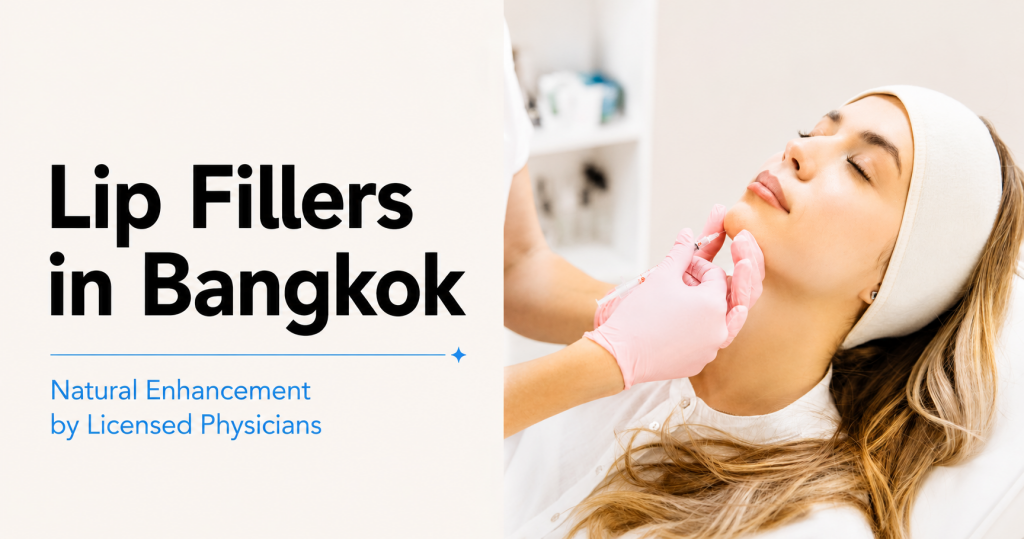
Lip fillers are medical-grade hyaluronic acid injectable treatments administered by a physician into and around the lips to restore volume, redefine shape, and improve hydration. HA is a polysaccharide that the body naturally produces to retain moisture in the skin, joints, and connective tissue.
As natural hyaluronic acid (HA) levels decline with age and UV exposure, the lips gradually thin, lose their defined contours, and develop fine vertical lines above and below the lip surface. Lip fillers address this structural loss. Modern products—including options such as Restylane Kysse, Juvéderm Volbella, and Neuramis—use cross-linked hyaluronic acid formulations that integrate with lip tissue to provide a soft, natural feel, typically lasting 6–12 months before gradually being absorbed by the body.
Beyond shape, many patients ask about the ‘glass skin lip’ look—a K-beauty-inspired aesthetic featuring luminous, smooth, plump-looking lips. This look is typically achieved not with heavy fillers but with precisely targeted hydration, using skin-booster formulations that enhance surface luminosity without significantly altering volume.
The Treatment Process
- Physician-led consultation. The doctor evaluates your facial proportions, reviews your medical history, and assesses your suitability—this is a medical consultation, not a sales pitch.
- Product Selection. The choice depends on your lip anatomy and your desired outcome (shape, volume, or hydration), using internationally recognized HA brands.
- Numbing (about 20 minutes). A topical anesthetic is applied; most modern HA gels also contain lidocaine to ensure comfort during injection.
- Treatment (about 15–30 minutes). Precise, physician-administered injection at specific anatomical landmarks, followed by gentle massage to ensure even distribution.
- Review and Aftercare. You'll review the results with the doctor before leaving, receive written aftercare instructions, and a 2-week follow-up appointment is available if you have any questions.
Who Is It Suitable For?
Lip fillers are generally suitable for adults seeking subtle enhancement, not dramatic transformation. At Bibi Clinic, the physician evaluates each patient’s suitability on a case-by-case basis during the consultation. Generally suitable candidates include:
- Those looking for subtle shape refinement, hydration, or a natural boost in lip volume.
- Those interested in ‘prejuvenation’—a conservative, early treatment administered before significant volume loss occurs.
- People with naturally thin lips, asymmetry, or age-related loss of definition.
- Patients who want a ‘refreshed, not altered’ look, tailored to their own facial proportions.
This treatment may not be suitable for individuals who are pregnant or breastfeeding, have an active infection or inflammation in the treatment area, or have a known allergy to hyaluronic acid or lidocaine. A qualified physician will assess your suitability and will always be upfront if fillers are not the right option for you.
Results, Duration, and Downtime
The typical lifespan is 6–12 months. The lips are constantly in motion—talking, eating, smiling—so HA tends to break down faster there than in the cheeks or chin. How long the results last depends on the product’s cross-linking density, your individual metabolism, lifestyle factors such as UV exposure and smoking, and the amount of filler injected. Individual results may vary; these figures are clinical averages and do not guarantee specific outcomes for any patient.
There is generally no required downtime, and most patients resume their normal activities the same day. For 24–48 hours afterward, it’s best to avoid intense exercise, alcohol, saunas, direct sunlight, and pressure on the lips (including sleeping face-down). Staying well hydrated and applying SPF 50 to the lip area helps HA integrate well and resist breakdown.
Possible side effects
- Common (expected, temporary): Swelling that peaks at 24–48 hours and usually resolves within a week; bruising in approximately 20–30% of patients, resolving in 5–10 days; mild tenderness for 2–3 days.
- Uncommon: lumps or asymmetry that can be gently massaged away in the first few days; the Tyndall effect (a bluish tint caused by filler injected too superficially), which can be treated with hyaluronidase; delayed swelling occurring 48–72 hours later.
- Rare but serious: vascular occlusion (accidental injection into or compression of a blood vessel), which can lead to skin necrosis or, in extremely rare cases, changes in vision—this is why physician-level anatomical knowledge is important; infection is rare when sterile technique is used; nodules may require dissolution with hyaluronidase.
Lip Fillers vs. Other Options
Not every lip filler experience is the same—the practitioner, the products, and the philosophy behind the treatment matter just as much as the injection itself.
| Factor | Bibi Clinic | Red flags elsewhere |
|---|---|---|
| Practitioner | Licensed MD; physician-led throughout | Non-medical staff administering injections |
| Products | Authentic, internationally recognized brands | Unbranded or suspiciously cheap products |
| Philosophy | Natural precision — shape-first, not volume-first | Template-based, trend-following approach |
| Safety | Hyaluronidase administered on-site; full medical history reviewed | No reversal agent is available on-site |
| Skin Diagnosis | VISIA® Imaging Pre-Treatment | Visual assessment only |
| Language | English, Japanese, and Thai | Language Barriers During Informed Consent |
Scroll sideways to see more →
Pricing at Bibi Clinic in Bangkok

Pricing for treatment is based on the filler brand and the volume required, which depend on your lip anatomy and your goals. The pricing information below is listed transparently; your exact volume will be determined during your consultation and is never estimated in advance.
| Product / Brand | Volume / Area | Price (THB) |
|---|---|---|
| Neuramis (Korea) | 1 cc syringe | 8,900 |
| Neuramis (Korea) | 2 cc syringes | 16,900 |
| Restylane Kysse (Sweden) | 1 cc syringe — lips | 13,900 |
| Juvéderm Volbella (USA) | 1 cc syringe — lips | 16,800 |
| SkinVibe (hydration booster) | 1 session — lips | 7,900 |
Scroll sideways to see more →
At Bibi Clinic, treatment is physician-led, featuring a full-face assessment and personalized dosing, as well as support in English, Japanese, and Thai. For the complete, up-to-date menu, see the Filler Treatment Page.
Frequently Asked Questions
I’m in my late 20s and have naturally thin lips. Is filler appropriate at this age?
Yes. The prejuvenation approach — Starting with conservative treatment before significant volume loss occurs — is well supported clinically. Small, precise doses in younger patients typically produce the most natural-looking results, because the underlying structural support is still intact.
Can I achieve the ‘glass skin lip’ look without obvious volume?
Yes. Hydration-focused treatments using soft HA formulations, or a skin booster such as SkinVibe, can add luminosity and a glazed surface texture without a significant change in volume. This is one of the most frequently requested lip treatments at Bibi Clinic.
Will my lips look obviously ‘done’?
Not with the approach Bibi Clinic takes. Results are tailored to your own facial proportions rather than a trendy template—the goal is for people to notice that you look better, not that you’ve had filler.
Can lip fillers be dissolved if I change my mind?
Yes—hyaluronic acid fillers are completely reversible. Hyaluronidase can dissolve the filler within 24–48 hours, and Bibi Clinic keeps hyaluronidase on hand at all times.
Is there any downtime after lip filler?
No mandatory downtime. Most patients resume their normal activities the same day, experiencing mild swelling for 24–48 hours that is typically subtle enough not to interfere with daily life.
References
- Evaluating Safety in Hyaluronic Acid Lip Injections: A Narrative Review. PubMed, 2021. https://pubmed.ncbi.nlm.nih.gov/34328377/
- Effectiveness and Safety of Hyaluronic Acid Fillers Used to Enhance Overall Lip Fullness: A Systematic Review of Clinical Studies. PubMed, 2019. https://pubmed.ncbi.nlm.nih.gov/30636365/
Ready to Take the First Step at Bibi Clinic?
The first step is always a free, no-obligation consultation with a physician.
Location: 3rd Floor, Hotel Nikko Bangkok, 27 Sukhumvit Soi 55 (Thonglor), Bangkok 10110
BTS: Thonglor Station — 3-minute walk
Hours: 9:00 AM – 8:00 PM daily
Languages: English, Japanese, and Thai
LINE: @bibi.official | Instagram: bibi.clinic
Links: https://bibi-beauty.com/en/
Disclaimer: This article is for informational purposes only and does not constitute medical advice. Individual results may vary. Please consult a qualified medical professional before undergoing any aesthetic treatment. Bibi Clinic’s physicians will assess your personal suitability during a consultation.
share


