
 LINE
LINE


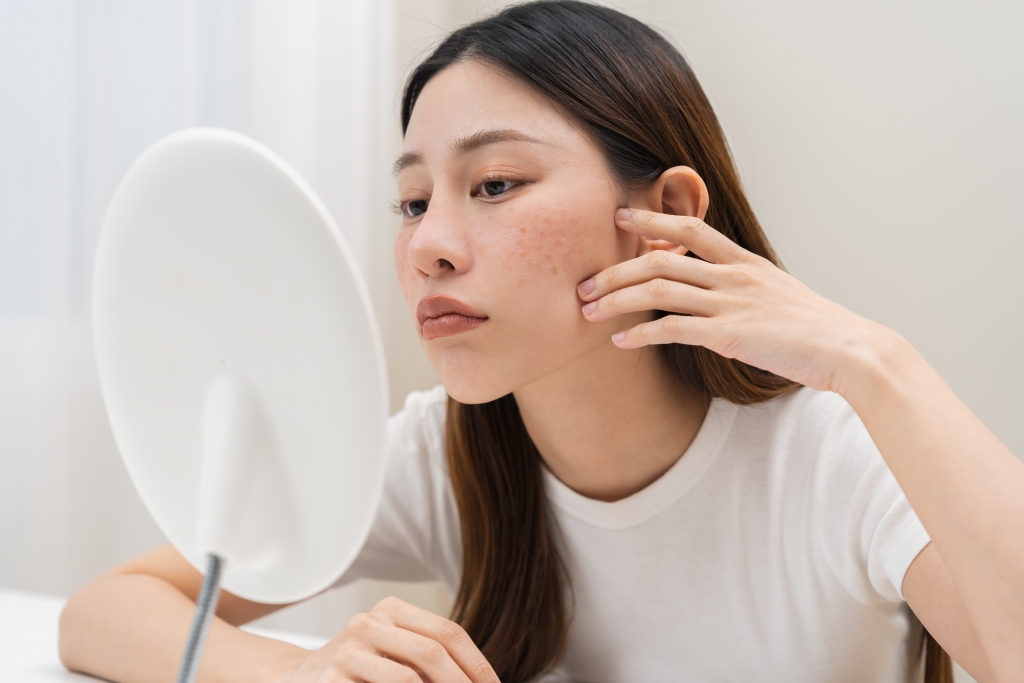
Laser spot removal is now one of the most familiar cosmetic treatments offered by many clinics.
But, "Do scabs really form?" Is it true that the scab will temporarily thicken? What if it fails?
In this issue, we will explain in detail the "real progress after laser spot removal" from the viewpoint of Bibi Clinic, which deals with the skin of many patients on a daily basis, and which cannot be seen only in advertisements and promotional messages.
If you are interested in having a spot removal laser treatment in Bangkok, Thailand, please read to the end.
How does the process proceed after laser spot removal? An easy-to-understand explanation by time
The skin after laser irradiation changes moment by moment over time. Let's take a look at the general process and what is happening in the background.
Day of treatment|Redness and burning are signs of a "normal reaction
Immediately after laser irradiation, you will often feel redness, tingling, and heat in the irradiated area. This is a normal inflammatory response due to the heat of the laser acting on the skin and is evidence that the treatment was effective.
Usually this symptom settles spontaneously within a few hours to two to three days at most.
Skin is extremely delicate during this period. Try to avoid touching the area after applying the prescribed ointment and applying protective tape. It is an ironclad rule that face washing and skin care should also be done gently, avoiding the affected area.
After 3 days to 2 weeks: "patience" with scabs
After a few days of irradiation, the area of the reacted spots will become a dark brown thin film (microcrust) or scab. It may be itchy, but avoid scratching it or forcibly peeling it off at this point.
In some cases, depending on the type of blemish, laser model, and power output, a clear scab may not form. Please be assured that the failure to form a scab does not mean that the treatment has failed.
After 1 month: "post-inflammatory hyperpigmentation," a concern for many.
After the scab has been removed, the skin, which looked temporarily clean, may turn brownish again about a month after the procedure. This is "post-inflammatory hyperpigmentation.
Many people are concerned that their spots may have reappeared. This phenomenon is triggered by the inflammation caused by the “stimulation” of the laser, which temporarily activates melanocytes and causes them to produce excessive amounts of melanin. Japanese skin tends to be relatively prone to post-inflammatory hyperpigmentation.
It is important to note that most post-inflammatory hyperpigmentation fades naturally over time. It usually settles down naturally in three to six months, or even a year in the longer term. The key to avoiding prolonged post-inflammatory hyperpigmentation is to not be in a hurry and to follow the thorough aftercare procedures described below.
Three aftercare procedures that can easily affect the course of a spot removal laser
It is no exaggeration to say that the progress after laser spot removal not only depends on the technique of irradiation itself, but also on the care at home after the treatment, so-called "aftercare".
Proper care is also important for post-treatment skin conditions, as it is believed to reduce the risk of post-inflammatory hyperpigmentation while taking into account downtime.
Here are three aftercare tips to be aware of to better prepare the process after laser blemish removal, along with specific methods.
UV protection: "shading" level awareness
The barrier function of the skin after the procedure is temporarily impaired, making it very susceptible to the effects of ultraviolet rays. Exposure to ultraviolet rays during this period is one of the causes of thickening and prolonging post-inflammatory hyperpigmentation.
Once the protective tape prescribed by the clinic is no longer needed, apply a hypoallergenic sunscreen (SPF 30/PA+++ or higher recommended) daily without fail. Even if you are indoors, UV rays are still falling through windows, so you must not let your guard down.
In addition, "shading," the physical blocking of light through the use of hats, sunglasses, parasols, etc., can also be used in conjunction with sunscreen to provide more reliable protection.
Especially in Thailand, where UV radiation is much higher than in Japan, it is important to take thorough measures against UV rays throughout the year.
Moisturizing: Supports healthy skin recovery
Dryness can disrupt skin turnover and delay the recovery of the barrier function. Adequate skin hydration is the foundation for maintaining a healthy skin renewal rhythm.
For sensitive skin after the procedure, choose products that do not contain potentially irritating ingredients such as alcohol or fragrance.
Simple, hypoallergenic lotions and creams with highly moisturizing ingredients are suitable. When applying, never rub the skin, but use a "hand press" technique to gently press the skin into the lotion with the entire palm of the hand.
Avoid friction: "don't touch" anyway.
Minor frictions in daily life, such as washing the face, wiping with a towel, skin care, and applying makeup, can cause significant irritation to the delicate post-treatment skin. This irritation can trigger a worsening of post-inflammatory hyperpigmentation.
When washing the face, lather the cleanser thoroughly, rolling the foam over the skin, and gently wash the face so that your fingers do not directly touch the skin.
When wiping away moisture with a towel, do not scrub, but rather gently press a clean towel against the face to absorb the moisture.
When applying skincare and makeup afterwards, the key to minimizing the burden on the skin is to relax the fingers and apply the product in a gentle gliding motion.
Bibi Clinic's valued "idea of laser spot removal."
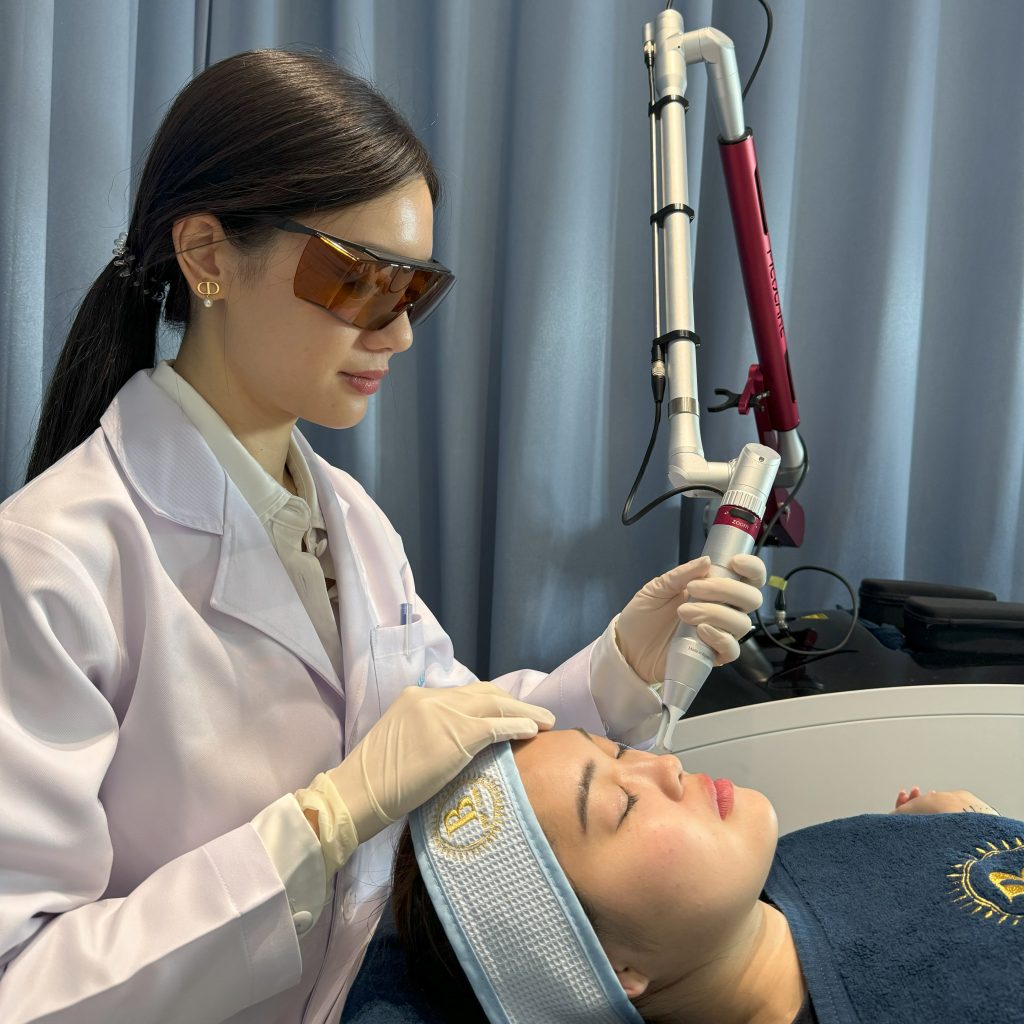
The results of blemish treatment are not solely determined by the performance of the laser equipment used.
At Bibi Clinic, we believe that the way in which the treating doctors and staff approach their patients is also an important factor that affects their satisfaction after treatment.
Here, we would like to share with you some of the perspectives that we value in our daily practice and the reasons why we value them, as we have dealt with the skin of many patients.
Considering “treatment” to include progress
The spot removal laser treatment does not end when the spots are irradiated. At Bibi Clinic, we believe that part of the treatment is how we monitor and support the patient's progress after the treatment.
For this reason, our clinic emphasizes the following three elements: 1) selection of an appropriate laser based on skin diagnosis, 2) detailed adjustment of irradiation output based on an assessment of the skin condition on that day, and 3) post-treatment course prediction and specific aftercare guidance based on that prediction.
By sharing the approximate progress in advance, we can monitor the progress with peace of mind, without feeling unnecessarily anxious about changes after the procedure.
Careful understanding of Japanese women's skin quality
It is known that Asian skin, including Japanese skin, is generally more reactive to irritation and prone to post inflammatory hyperpigmentation (PIH).
Therefore, it is important to accurately assess the characteristics of each person's skin type and blemishes before considering the details of the procedure, rather than irradiating the laser according to Western standards or uniform settings.
In particular, Japanese people living in Thailand, where ultraviolet rays are strong, must also take into account the accumulation of damage to their skin, which is different from that in Japan.
Because of the overseas environment, one of the key factors in selecting a clinic is whether or not they are familiar with the unique and delicate skin characteristics of Japanese people, and whether or not they can provide detailed explanations and personalized treatment based on their extensive clinical experience.
Proper knowledge of the process of laser spot removal is a shortcut to beautiful skin.
The process after laser blemish removal usually begins with redness, followed by scabbing, and then temporary pigmentation, which gradually adjusts to the skin. This process varies from person to person and can take several months.
The important thing is to understand this sequence of events in advance and not to be overly concerned or sad about daily changes.
Then, basic aftercare, such as UV protection, moisturizing, and avoiding friction, should be continued to the extent that is reasonable. These are basic points to be aware of in order to stabilize the skin condition after laser treatment.
At Bibi Clinic, we value the spot removal laser not as a mere procedure, but as a process of dealing with the skin. If you are considering spot treatment in Thailand, please contact us for a consultation.
▷Vivi Clinic's spot removal laser treatment isthis way (direction close to the speaker or towards the speaker)
▷To consult or make an appointment at the Bibi ClinicClick here
share


