
 LINE
LINE


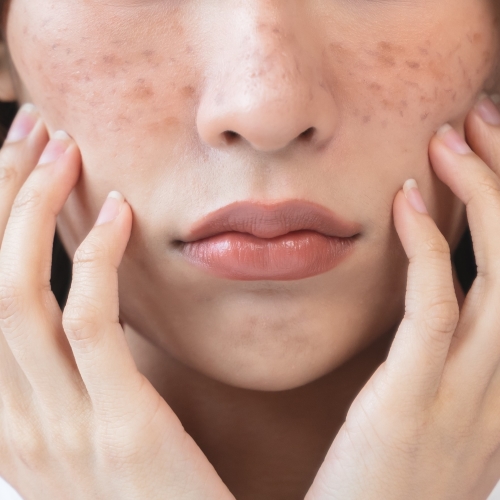
After the irradiation of a laser to remove blemishes, a "scab" may form on the treated area. This is a process experienced by many people who have undergone laser treatment, and we will explain the reasons for this and the questions that may arise if the opposite is not possible, based on our general clinical experience at a beauty clinic in Bangkok, Thailand.
Why do spot removal lasers cause scabs?
Scabbing after laser blemish removal is a reaction seen as part of the skin's recovery process.
The mechanism begins with the laser applying thermal energy to the melanin pigment, which is the cause of blemishes, and breaking it down into smaller pieces. At this time, the skin in the irradiated area undergoes a very mild inflammatory reaction, which activates the skin regeneration process.
The broken-down melanin pigment is gradually processed through the skin's metabolism and inflammatory response, and the color tone fades over time. During this process, a temporary "scab" is formed to protect the damaged skin and promote regeneration.
The general process is as follows
| time | Skin condition |
| Immediately after treatment | Redness and tingling sensation may occur. |
| several days later | Temporary darkening of the irradiated area may be observed and a thin scab may form. |
| Around 1 week | The scab peels off spontaneously. |
| thereafter | The skin appears temporarily pink and blends with the surrounding skin tone over time. |
This sequence of events is a sign that the skin is being renewed into new cells.
No Scabbing = Failure? A point that is often misunderstood.
On the other hand, we are often asked, "If the spot removal laser doesn't scab over, did it not work?" We are often asked this question.
You can find a variety of information on the Internet in the wisdom section, but in conclusion, just because a scab does not form does not necessarily mean that the procedure was a failure.
Post-treatment reactions vary greatly depending on the type of blemish (senile pigmentation, freckles, ADM, etc.), the depth of the blemish, and the type and power of laser used.
For example, for thin spots or spots in the shallow layers of the skin, there are many cases in which the color fades as if a thin skin is peeling off, with little scab formation.
Also, after a laser spot removal, the spot may not scab over and the treated area may remain as a dark spot, remain brown and not seem to change much, or remain red.
In most cases, these are caused by the process of processing melanin after laser irradiation or mild inflammatory reactions after the procedure, but if you are concerned, it is important to consult the clinic where you received the treatment, rather than making your own judgments.
The important thing is that the physician assesses each individual's skin condition and selects the best approach for that particular blemish, rather than being sanguine about the presence or absence of a scab.
Receiving an explanation of the likely course of treatment prior to the procedure is the key to peace of mind.
How to properly spend the scab period after laser spot removal
If scabs form, the most common concern is "when will scabs come off after laser spot removal?
Usually, the scab will fall off naturally in about 7 to 10 days. Aftercare during this period greatly affects the condition of the skin after the procedure, so be sure to spend time appropriately.
Of particular importance is to wait for the scab to peel off naturally. It usually comes off naturally in about 7 to 10 days, but never forcefully peel it off, as this can cause hyperpigmentation and inflammation.
There are three points in particular to keep in mind
- Thorough UV protection
After the scab has lifted, the skin is extremely delicate. Use sunscreen as well as hats and parasols. Especially in Bangkok, Thailand, where the sun is strong throughout the year, it is no exaggeration to say that UV protection can make the difference between success and failure of the procedure. - Adequate moisturizing
Dry skin leads to a reduction in the barrier function, weakening the skin's ability to protect itself from external stimuli. Use a non-irritating moisturizer to keep skin moist at all times. - avoid friction
When washing your face, avoid scrubbing or wiping hard with a towel, which can be hard on the skin. The key is to wash your face gently with plenty of lather and then gently wipe off the moisture.
Our meticulous aftercare, which takes into account the climate and lifestyle of Bangkok, Thailand, leads to beautiful results.
Bibi Clinic's 3-step blemish treatment that prepares the skin from its foundation.
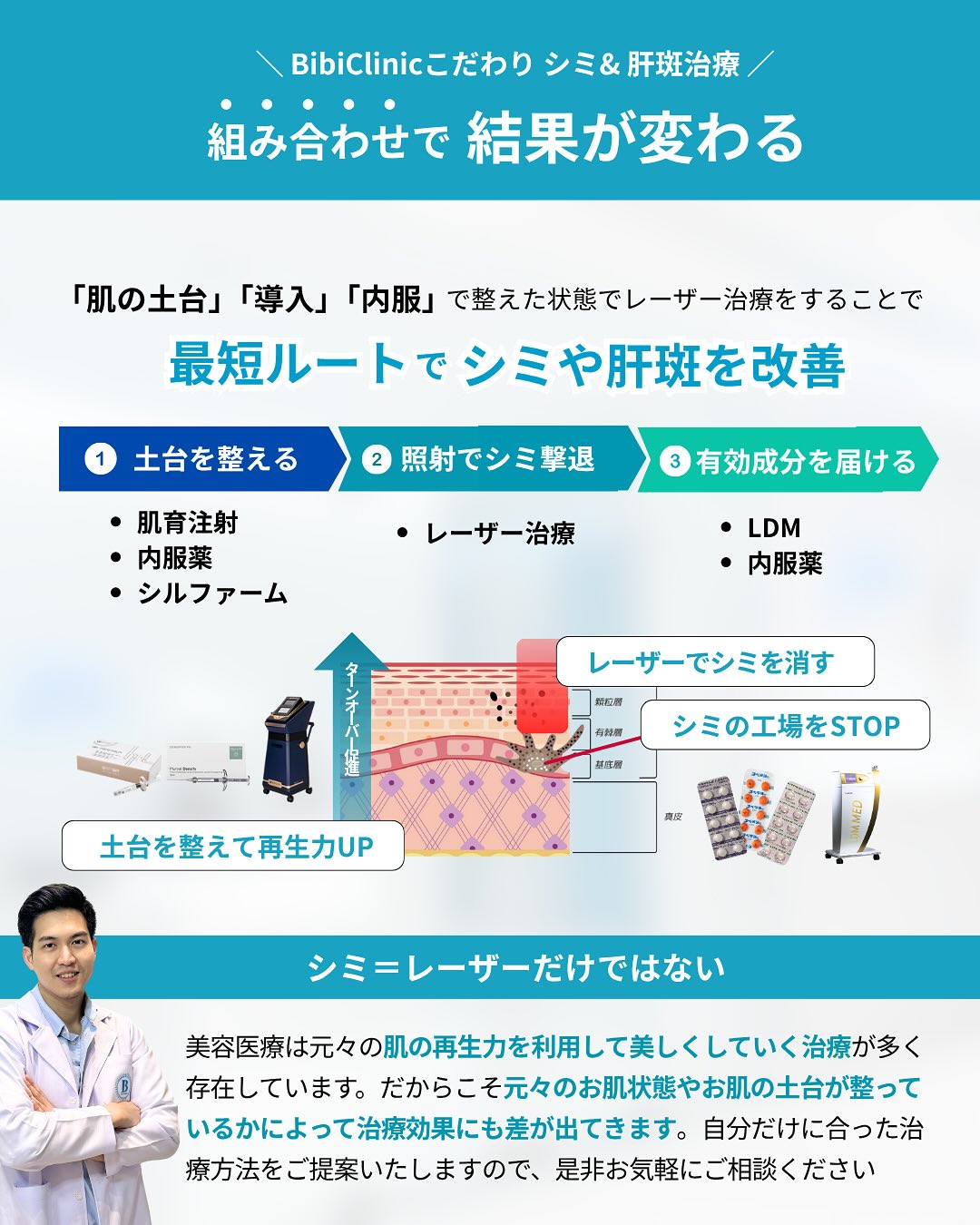
Many people may have the image that "blemish removal treatment = laser. However, the basis of beauty is to lead the skin to a beautiful skin impression by utilizing the skin's natural healing power. That is why the effectiveness of laser blemish removal is greatly influenced by the condition of the skin, which is the foundation of the treatment.
At Bibi Clinic, we believe that a combination treatment, rather than a single treatment, is the shortcut to improvement of blemishes. Therefore, we propose the following three-stage blemish treatment.
- Preparation phase: Preparing the skin foundation
In order to bring out the effects of the laser, we first condition the skin. We aim to improve the skin texture with Silpharm X and skin growth injections, as well as from within the body with oral medications, in order to improve the foundation of the skin. - Execution phase: direct approach to blemishes
The appropriate laser is irradiated to the prepared skin by determining the type and depth of the blemish. Since the foundation of the skin is well prepared, the laser responds well and a higher effect can be expected. - Sedation and maintenance phase: aftercare and recurrence prevention
After the procedure, the skin is gently soothed with LDM (high-density ultrasound). In addition, oral medications are continued to make the downtime comfortable and approach the risk of recurrence of spots.
Thus, while laser treatment is the mainstay of the treatment, we aim to combine pre- and post-treatment care to ensure safety. This is the approach to blemish treatment that Bibi Clinic values.
With the right knowledge, you can feel confident about spot removal laser treatment.
Scabbing after a laser spot removal is one of the normal reactions seen during the skin's recovery process. If a scab does not form, it is a reaction to the type of blemish and treatment and is not a failure.
It is important to understand that the course of treatment varies from person to person and to practice proper aftercare.
When undergoing cosmetic treatment abroad, especially in Bangkok, Thailand, you may feel uneasy due to language and cultural differences.
That is why it is important to make sure that there is an explanation and follow-up system in place before and after the treatment.
▷Vivi Clinic's spot removal laser treatment isthis way (direction close to the speaker or towards the speaker)
▷To consult or make an appointment at the Bibi ClinicClick here
share


